 Polski
 Čeština
 English
 Deutsch

Professional bra fitting
HOW TO GET A PERFECTLY FITTING BRA?
When choosing bras, women often pay more attention to selecting the color and style, while the key is choosing the right size.
- 80% of the support in a bra comes from the lower part of the bra, then
- 10% comes from the straps
- 10% from the cups
that is why a properly fitted bra band is so important.
A beautiful bra is only half the success. To look attractive on the bust, enhance it, support it well and, above all, showcase it, it must be matched to the breast shape and size. An unsuitable bra (too small or too loose) will not fulfill its basic function. Instead of supporting, enlarging and showcasing the bust, it will distort it. When choosing a bra, it is worth paying attention to the cup construction, bra size, and the quality of the material and workmanship.
A. UNDERBUST BAND
- It is the most important part of the bra, providing the breasts with 80% of proper support.
- A securely fitted bra band, not tightly stretched straps, supports the bust.
- If it is too loose, it rides up at the back, causing the bust to lose proper support.
- When choosing a bra, select a smaller band size than your actual chest measurement, e.g. if your measurement is 76 cm, choose a 70 cm band. Remember that we cannot always reduce the band size. Every woman has a different body shape and compression is not always advisable. It may cause pain or discomfort. Talking with the customer gives us insight into how she feels.
- Fasten the bra on the loosest, outermost hook.
- A properly fitted band lies flat against the body, does not ride up when you raise your arms, and the breasts do not slip out from the bottom.
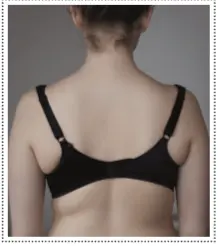
BRA BAND RIDING UP
A bra whose band fits snugly against the body will provide comfort and ease of wear, because a properly fitted band does not need constant adjustment (i.e. pulling down).
To make sure you have the correct band size, do a small test: raise your arms, bend a few times, or jump a little. If during these movements the bra band did not move up toward your neck, everything is fine. Congratulations! If, however, it ended up higher than the line of the bottom of your underwires, and additionally the bust slipped out from the bottom during sudden movements, choose a tighter bra band size.
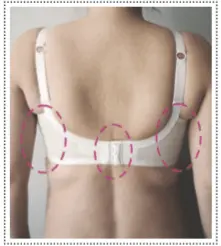
OVERLY TIGHT BRA BAND
A bra band that is too tight digs into the body. In a properly fitted bra band, the straps should lie parallel to each other or form a slight V-shape.
If the straps are too far apart, or even form an inverted V, it is a sign that the band you chose is definitely too tight.
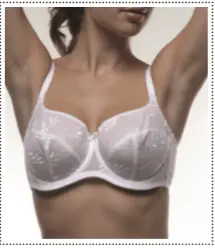
UNDERWIRES ON THE BREASTS
A bra band that is too loose, failing to do its job, allows the bra to ride up, causing the lower part of the underwire to sit on the breast.
Choose a more stable bra band.
B. CUPS
- They should cover the entire breast without creating a "bulging" effect at the top of the bra or under the arms.
- The nipple should be located at the deepest point of the cup, right in the center of the bra.
- The breasts should be lifted and separated from each other.
- The underwires should completely encircle the breasts, not dig into them or extend onto the back.
- If the cup wrinkles at the top where it meets the strap, it means the cup is too big.
- If wrinkling occurs in the middle of the cup, paradoxically, it means the cup is too small.
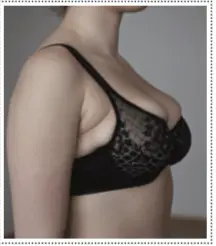
BULGES ABOVE THE TOP EDGE OF THE CUPS AND WRINKLING IN THE MIDDLE
If the breasts spill out of the top of the cups, creating unsightly bulges, it is a sign that the cup size you are wearing is definitely too small. If there is also wrinkling in the middle of the cups, this also indicates that the cup size is too small. You should choose a cup at least one size larger.
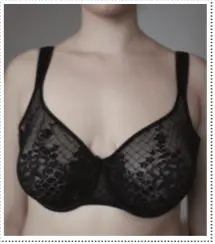
TOO LOOSE CUPS
If you notice wrinkling in the upper part of the cups and/or that they are bagging, choose a smaller cup size.
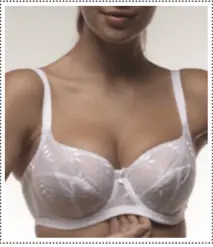
CENTER GORE STANDING AWAY FROM THE BODY
In a properly fitted cup, the center gore between the cups should lie smoothly against the body. If it does not and the center gore stands away from the chest, it is a sign that the chosen cup is too small. It causes the breasts, trying to fill the too-small cup with their volume, to push the bra's center point (the center gore) away from the body. Choose a cup at least one size larger.
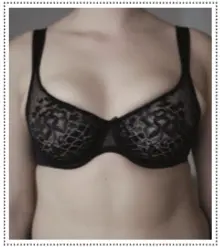
UNDERWIRES DIGGING INTO THE BREASTS
The underwire should outline the shape of the breast and encircle it perfectly from every side, without causing pain from the wire digging into the breast. The end of the underwire should point toward the center of the armpit. However, if the underwires dig into the breasts, you need a larger cup.
C. STRAPS
- It is not the straps that lift the bust. The basis of breast support lies in the "shoulders" of a properly fitted bra band, and the straps serve only a supplementary role.
- Remember - 80% of bust support comes from a securely fitted bra band and only 20% of the supporting function comes from the straps.
- The straps should not be overly tightened, only slightly taut.
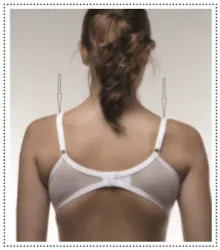
STRAPS DIGGING IN
Straps digging into the shoulders are a sign of a bra band that is too loose. The lack of support from the band is replaced by straps stretched to their limit, which causes redness on the skin and significant discomfort in the form of persistent back and spine pain.
We recommend loosening the straps. If this causes the bust to lose stability and support, choose a tighter bra band.
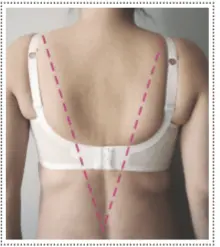
STRAP POSITION
The straps should be positioned parallel to each other or form a slight incline in the shape of the letter "v". If the straps are too far apart, or even form an inverted "v", this is a sign that the chosen band is definitely too tight.