Polski
 Čeština
 English
 Deutsch

Materials
LACE
Lace is an openwork, patterned fabric with tulle elements, made by machine or by hand. The openings may be created by removing threads or fabric from a previously woven material, but most often they are an integral part of the lace.
Lace-making is an ancient craft. True lace did not appear until the late 15th and early 16th centuries. True lace is made when thread is looped, twisted, or braided with other threads, regardless of the backing fabric.
Originally, linen, silk, gold, or silver threads were used. Cotton threads are also often used. Manufactured lace can be made from synthetic fiber. Contemporary artists also create lace using thin copper or silver wire.
| There are four types of lace: | |
| Leavers lace: | woven, the most valuable lace |
| Jacquard lace: | knitted, thicker, with a distinct pattern |
| Textronic lace: | knitted, closely imitating Leavers lace |
| Rachel lace: | knitted, with a flat pattern |
HISTORICAL LACE
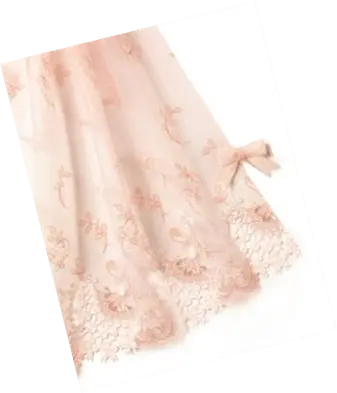
Guipure lace, also known as "Venetian" lace, is one of the oldest and most elegant laces.
The motif is made with dense embroidery. The backing material is then removed, leaving only the ornament.
One of the oldest types of lace

LYCRA®
Before the introduction of Lycra®, designers did not have body-hugging materials at their disposal. Bras in the 1950s and 1960s were made of stiff, non-stretch materials, which is why the cups had a pointed shape. The introduction of Lycra® revolutionized the textile industry by offering a wider choice of materials and enabling changes in design.
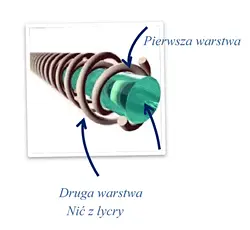
Lycra® is a synthetic fiber whose main advantage is elasticity. However, it is a rather weak fiber, because when stretched in its raw form, it breaks. To be suitable for use, it must be covered with other threads.
The Lycra® fiber is secured with a single or double layer of thread. The denser the covering, the more resistant and more expensive it is. Modern Lycra® is used in this form.
3D SPACE SYNTHETIC FIBERS

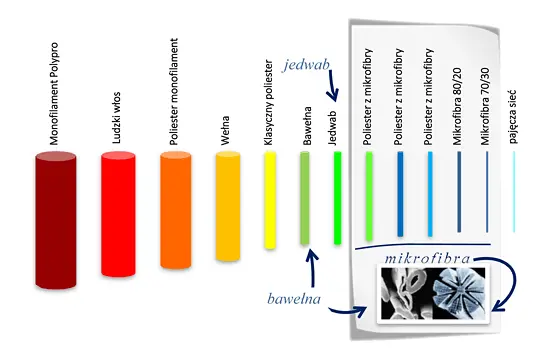
Microfiber is the finest synthetic yarn; it has the same properties as silk and cotton. It is a lightweight, breathable fabric that adapts to body temperature. In summer, the fibers draw heat away from the body and disperse it. In winter, microfiber insulates the body by retaining natural warmth. Women who prefer natural fabrics can wear microfiber and enjoy the same properties.
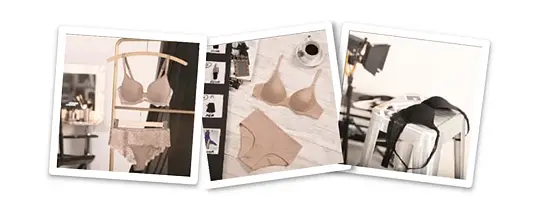
Due to its softness, microfiber is perfect for lingerie production, creating a second-skin effect. This thin fabric, finished with laser cutting or bonded seams, ensures complete invisibility and comfort while retaining the properties of a natural fabric.
WOVEN LACE
The Leavers weaving technique is the oldest mechanical method of producing lace. It is the only type of lace that can be called "Calais lace".
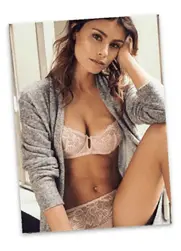
Leavers lace is woven on mechanical looms. It is the most sophisticated type of lace. The warp is very elaborate, and the wefts used are of high quality. There are no restrictions on the types of threads used, which makes it possible to create exceptionally subtle patterns and colors.
All Leavers lace is still produced in Calais. Most of the Leavers lace produced today is used by lingerie companies, Haute Couture, or Prêt-à-Porter. The authenticity of Leavers lace is confirmed by the "Dentelle de Calais®" label.
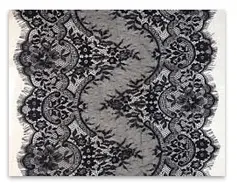
Chantilly lace: this is a type of Leavers lace. Its delicate motifs give it a light, "spiderweb" appearance.
| Leavers lace | the oldest mechanical lace-making technique (19th century) |
| Calais lace | lace made in the Calais region on a Leavers loom |
KNITTED LACE
Textronic® lace, produced on warp knitting machines, creates a deep relief effect in which the background pattern can be changed. In this way, Textronic® lace resembles Leavers lace.
Textronic® and jacquard laces may contain only two types of threads (e.g. polyamide and cotton, possibly with elastane throughout to provide elasticity). This limits color combinations to a maximum of two.
Some Textronic laces are still produced in France and Europe, but a large share now comes from China, as this significantly reduces their cost. However, Simone Pérèle uses ONLY French and European lace.
In France, you can find the latest technology and machinery, which combined with skill and cultural heritage make it possible to produce the highest-quality lace.
This lace can be finished with delicate and decorative fibers.
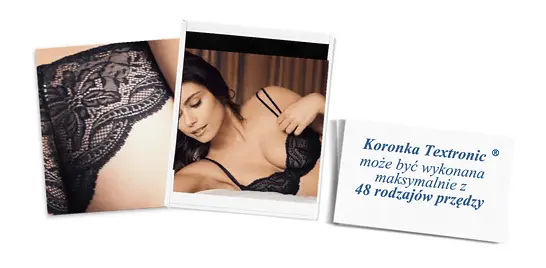
The Textronic® lace requires finishing; otherwise, it will unravel.
It can be made using a small number of threads.
It has the maximum number of rows (48).
Jacquard® Lace
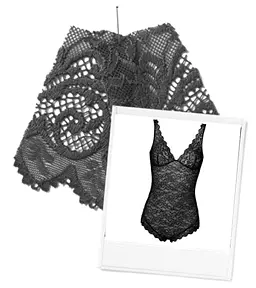

Jacquard® Lace, also produced on warp knitting machines, is flat, without relief, but with motifs in the background. This type of lace is simpler than Textronic® lace, but also cheaper.
This technique produces 500 stitches per minute, which is why Jacquard® lace is manufactured very quickly.
| Jacquard® Lace vs Textronic® Lace | |
| Thick texture, high material volume, low transparency | Very delicate and transparent lace |
| 200 fibers are used | 2,000 (or more) fibers used |
| Yarns are used together | Yarns used in separate threads |
| Background and pile woven in 66 rows | Background and foreground woven in 120 rows |
| One fabric width. | Background and foreground woven in 120 rows |
Jacquard® requires finishing; otherwise, it will unravel.
It can be made using a small number of threads.
It has the maximum number of rows (66).
3D SPACER
3D Spacer is a unique fabric created using technologically advanced monostrand yarns. The revolutionary effect of this bra with a 3D cup provides a round, natural shape without adding volume to the bust, while allowing the skin to breathe. The material is smooth and gentle on the skin and guarantees the highest comfort.
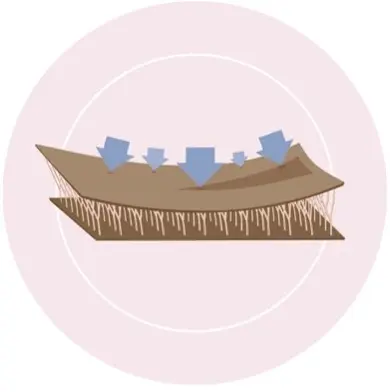
- The special structure of 3D spacer material allows the skin to breathe.
- It creates a rounded, natural shape without adding volume.
- It ensures the highest comfort.